








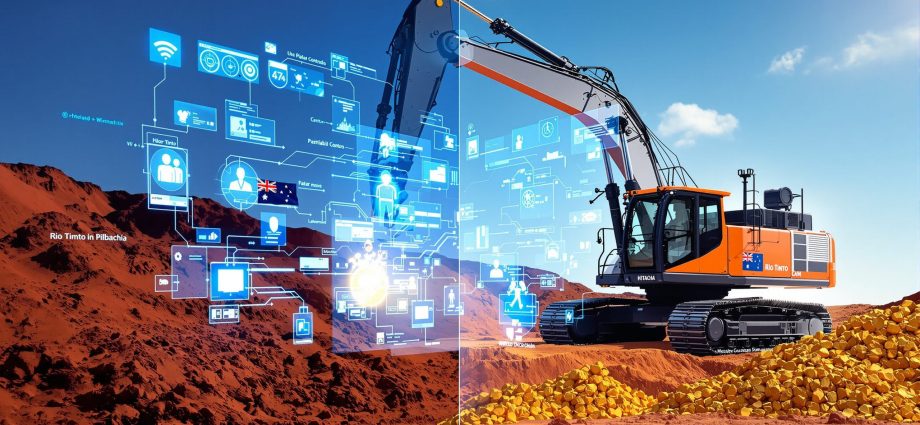
Modern mining operations are becoming increasingly complex, with vast equipment fleets generating enormous volumes of operational and sensor data. This shift has created new opportunities for advanced analytics and artificial intelligence (AI) to reshape maintenance management, productivity optimisation, and long-term capital planning. The integration of AI capabilities with traditional heavy-equipment engineering expertise marks a pivotal evolution in global mining technology strategy.
The industry’s transformation is reflected through strategic partnerships bridging established manufacturers and specialised AI developers. Hitachi’s US$3 million investment in Rithmik Solutions demonstrates how major equipment suppliers are pursuing targeted capital deployment to access sophisticated analytical capabilities while maintaining disciplined evaluation of emerging technologies. This approach enables manufacturers to modernise their digital offerings without taking on the full risk of early-stage innovation.
Mining companies face intensifying pressures—from escalating maintenance costs and environmental compliance requirements to labour shortages and aggressive production targets. With unplanned downtime costing the global mining sector an estimated US$20–25 billion annually and maintenance accounting for 25–35% of total operating costs, data-driven solutions offer a compelling pathway to operational resilience.
Advanced analytics platforms now continuously process real-time equipment data, allowing operators to compare actual machine performance against design specifications and identify inefficiencies that traditional maintenance schedules often overlook. Technologies such as the LANDCROS Connect Insight platform, launching in April 2025, collect near real-time machine data and pair it with AI tools to produce tailored operational insights far more precise than manufacturer benchmarks alone. Field trials conducted from August 2024 to July 2025 across fleets of dump trucks and hydraulic excavators further illustrate the value of AI in detecting anomalies early and preventing damage escalation.
AI-enabled systems have demonstrated significant operational improvements, including 35–45% reductions in downtime, 25–30% decreases in maintenance expenses, and the ability to predict equipment failures with up to 92% accuracy weeks in advance. Modern anomaly detection architectures integrate supervised learning trained on historical failure patterns with unsupervised models capable of identifying new anomalies, while time-series algorithms track degradation trends and multi-variable analysis links operational behaviours to emerging risks.
Strategic capital deployment models in mining technology now span minority equity stakes, joint development programmes, and full acquisitions. Minority investments ranging from US$1–5 million provide access to innovation while allowing manufacturers to evaluate technology alignment. Deeper co-development efforts in the US$5–15 million range target platform integration, while acquisitions above US$15 million aim for full control of market-shaping technologies. This mirrors broader sector trends, with venture funding into mining technology rising 42% between 2022 and 2024 to reach US$4.8 billion.
Open platform architectures are also becoming a competitive differentiator as mining companies increasingly operate diverse fleets of 8–12 equipment brands, including legacy machines that represent up to 60% of active assets. Operations that adopt standardised data formats across mixed fleets report 35–45% reductions in integration costs, while API-driven interoperability can cut third-party analytics integration timelines by more than 60%. This openness enhances flexibility, reduces vendor lock-in, and positions mining companies to adopt best-in-class technologies more readily.
Projected environmental benefits of AI-driven optimisation are equally substantial: fuel consumption reductions of 30–40%, 20–25% decreases in component turnover, and 15–20% improvements in overall energy efficiency. Better equipment monitoring also supports sustainability reporting, resource planning, and long-term asset efficiency.
Global market dynamics further influence AI adoption patterns. North America leads in AI software development, Asia in equipment manufacturing, Europe in regulatory frameworks, and Australia/Canada in field testing and operational validation. Meanwhile, emerging markets are accelerating adoption as mature AI systems demonstrate proven ROI and operational reliability.
Implementation challenges remain significant—including legacy system integration, sensor calibration, data quality management, industrial cybersecurity, and workforce readiness. Successful adoption requires clear data standards, robust communication protocols, secure IoT frameworks, and scalable architectures capable of supporting multi-site deployments. Human capital development is increasingly critical, as operations shift toward data-driven decision-making and AI-assisted workflows.
Technology roadmaps indicate that by 2030, mining operations will see expanded autonomous equipment coordination, advanced digital twin modelling for simulation and risk planning, and deeper integration into industrial IoT ecosystems. Beyond 2030, fully autonomous, smart mining environments are expected to emerge as AI systems mature and regulatory frameworks evolve.
The convergence of AI with established heavy equipment manufacturing offers mining companies unprecedented opportunities for productivity gains, cost optimisation, environmental improvement, and competitive advantage. Strategic partnerships between innovators and large OEMs will continue accelerating this evolution, providing the mining sector with practical pathways to adopt advanced analytics across global operations.
