







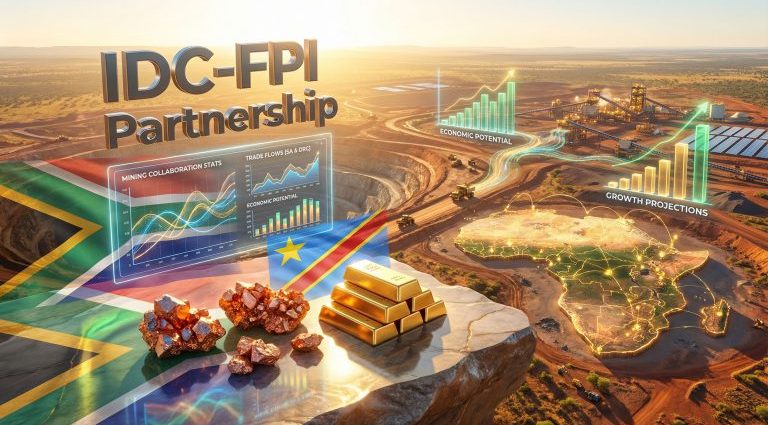
Regional development finance architecture in Africa is evolving beyond traditional bilateral agreements toward more integrated, risk-sharing cross-border investment mechanisms, particularly in the mining sector. The growing collaboration between South Africa and the Democratic Republic of Congo (DRC) illustrates this shift, as development finance institutions (DFIs) structure partnerships designed to support long-term, capital-intensive resource projects. Unlike commercial lenders, DFIs are better equipped to navigate regulatory complexity, assess political risk, and provide patient capital aligned with infrastructure timelines and social impact considerations that large-scale mining operations require.
South Africa’s Industrial Development Corporation (IDC), established in 1940 as a state-owned development financier, brings decades of industrial investment experience to continental partnerships. With full government ownership, the IDC operates under a mandate focused on strategic economic development rather than short-term profit maximisation, allowing it to deploy long-term capital into complex ventures. In contrast, the DRC’s Fonds de Promotion de l’Industrie (FPI), created in 1989, follows a different funding model, generating capital through import levies and taxes on industrial goods. The FPI has financed more than 600 projects across the DRC, building strong local institutional networks and regulatory familiarity. Together, these institutions offer complementary strengths: the IDC provides large-scale industrial financing expertise, while the FPI contributes local market integration and project-level support.
Risk-sharing between DFIs enables project structures that would be difficult for single-country entities to execute independently. Political and sovereign risk can be distributed across jurisdictions, currency exposure can be managed through dual-country revenue frameworks, and technical expertise can flow in both directions. South Africa contributes advanced mining technologies, refining capacity, and infrastructure experience, while the DRC offers world-class mineral endowments and deep geological knowledge.
Continental integration is central to Africa’s long-term mining transformation. The DRC is Africa’s largest copper producer and holds significant reserves of cobalt, tin, gold, coltan, and rare earth elements. Notably, it controls an estimated 3.6 million tonnes of cobalt reserves—approximately 60% of global reserves—yet much of the processing capacity remains concentrated outside the continent. South Africa, by contrast, possesses more advanced processing infrastructure and technical capabilities. This complementarity creates an opportunity to develop integrated extraction-to-processing value chains within Africa, increasing value capture and reducing dependence on foreign refiners.
Copper-cobalt integration presents one of the most immediate opportunities. DRC copper ore grades typically range between 2% and 4%, well above global averages of 0.6% to 1.2%, while cobalt is often produced as a byproduct requiring advanced separation technologies. South African expertise in refining and metallurgical processes can enhance efficiency and quality control, positioning the region more competitively in global battery metals markets. However, infrastructure gaps—particularly in transportation—remain a constraint. Developing rail corridors linking DRC mining regions to South African ports could significantly reduce logistics costs compared to existing routes through East Africa.
Modern mining partnerships increasingly rely on collaborative project development models that combine equity sharing, technology transfer, and joint operational management. Typically, South African partners contribute processing technology and infrastructure expertise, while Congolese partners provide mineral rights and local operational knowledge. Blended financing structures—mixing concessional development finance with commercial capital—help lower overall funding costs while maintaining project viability. Risk distribution mechanisms address political stability variations, currency volatility, regulatory compliance, and infrastructure cost-sharing, creating more resilient investment frameworks.
These developments unfold against a backdrop of shifting global supply chain dynamics. Demand for critical minerals such as cobalt and copper is accelerating due to electric vehicle adoption and renewable energy expansion. Although the DRC accounts for roughly 70% of global cobalt production, approximately 80% of cobalt refining occurs in China, creating concentration risk in global supply chains. This imbalance presents an opportunity for African nations to develop integrated processing capacity that enhances supply security while capturing greater economic value. At the same time, international buyers increasingly prioritise environmental, social, and governance (ESG) compliance, making responsible sourcing and low-carbon operations essential for market access.
Collaboration opportunities extend beyond battery metals. Renewable energy integration into mining operations can reduce operational costs while improving sustainability performance. Lithium processing—supported by regional discoveries in countries such as Zimbabwe and Zambia—represents an emerging area of potential regional cooperation. In traditional sectors, gold refining collaboration can formalise artisanal mining activities in the DRC while leveraging South Africa’s long-standing precious metals expertise. Rare earth element extraction and processing also offer strategic prospects, particularly as global markets seek alternatives to concentrated processing hubs.
Infrastructure development remains a critical catalyst for successful cross-border mining collaboration. Coordinated investment in transport corridors, shared energy systems, digital connectivity, and technical training facilities can support multiple projects while delivering broader economic benefits. Integrated mining operations could generate tens of thousands of direct and indirect jobs across extraction, manufacturing, logistics, and services. Structured skills transfer programs, including large-scale technical personnel exchanges, would accelerate technology diffusion and strengthen long-term operational independence within the region.
Ultimately, a regionally integrated mining finance architecture anchored by development finance institutions offers Africa a pathway toward greater value chain participation, reduced geopolitical vulnerability, and enhanced economic resilience. By combining resource endowments, technical capabilities, and patient capital within structured cross-border frameworks, South Africa and the DRC can lay the foundation for a more competitive and self-sustaining continental mining ecosystem.
